Working in a video store or in a hospital?
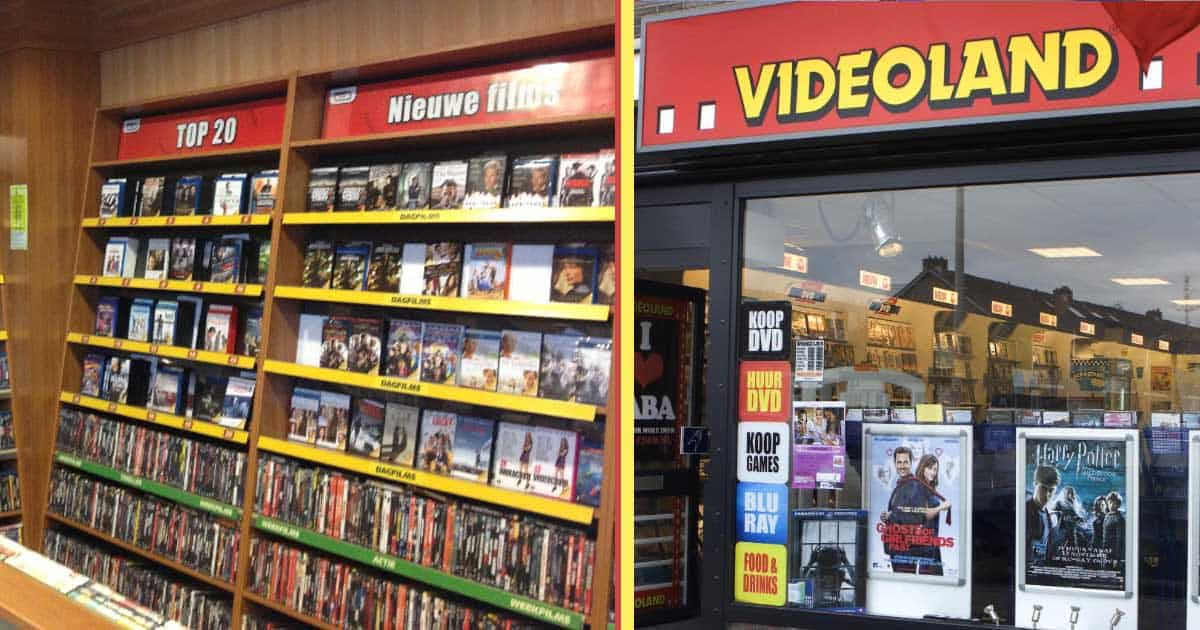
The best part-time job I ever had was working in a video rental shop. I told my kids about it recently, but they didn't understand what a "videotheek" (video rental shop) even was. Once I'd explained it, they apparently decided I was suddenly a boomer. Sigh.
Back to my favourite part-time job, at Videotheek Hollywood on the Daalseweg in Nijmegen. What was so great about it? Pretty much everything. I'm still an enormous film lover, and back then, as an impoverished student, I got to watch unlimited films for free. That was even expected of the staff, so we could give customers good advice. That was another great aspect of working in the video shop; giving advice. In my current job I still do that; sometimes asked, and often unasked.
With customers in the video shop, the trick was to work out what appealed to them in a film. At some point I realised it worked well to ask them for their three favourite films. Then you could usually guess which film would suit them. Nowadays there's A.I. for that; "…customers who bought this product also liked…".
The customer who has stuck with me the most was a boy who always rented Disney films and horror films. I once asked him where that peculiar combination of genres came from. He told me he couldn't read, and that this meant he could only follow Dutch-language cartoons and horror films with as little text as possible. You experience all sorts of things in a video shop.
How much harder the medical profession seems to me nowadays. The "customers" aren't customers, because they don't choose to get ill. For that reason alone, the idea of "market forces in healthcare" strikes me as a disastrous route. Patients don't choose to be ill, which also means that most people won't walk into the consulting room cheerful and relaxed.
“The customers aren't customers, because they don't choose to get ill.”
In 2013 I attended the ESMO congress in Amsterdam. There I read a poster about burnout symptoms among young, European oncologists. As many as 80% suffered from them. Ever since, this topic has held my attention; how do doctors experience their profession?
Double ageing
Double ageing (an ageing population that is also living longer with more conditions) not only puts more pressure on healthcare because of the growing volume of demand, the problems are also becoming more complex. Where a patient used to come in with a single condition, nowadays it's increasingly common for a patient to already have two or three conditions, on top of which a fourth condition then appears. In concrete terms, this means that for the practitioner the work shifts from "making the right diagnosis and starting the right treatment" to "puzzling out how best to tackle that fourth condition".
A second notable consequence of double ageing is the shift in GP care from "family doctor" to "companion in dying". Where the GP's work used to strike a nice balance between maternity care, paediatrics and elderly care, the emphasis now lies on palliative care.
Identity shopping
The second trend we identified was what we call "identity shopping"; the patient assembles their own care piecemeal. The selection criterion here is their self-perceived identity. Professional footballer Matthijs de Ligt put it beautifully: "I am a top athlete. I am an athlete. So I don't need a coronavirus vaccine." Choosing your own care based on your identity.
What makes it complicated is that patients increasingly have care needs that the healthcare system doesn't fully cater for. A nice example of this was the story of a GP practice that was asked by a patient how the remote control worked. On the face of it a laughable incident, but the underlying problem is serious and growing: loneliness.
What alarmed me most in this research: almost all the GPs we spoke to were seriously considering quitting their work within the next five years.
Social media
Social media takes things fundamentally further than Dr Google: suddenly everyone is a writer. Every social media user has their own printing press at their fingertips. Combined with the individualisation of society, everything suddenly becomes an opinion that must be treated with respect. Any random opinion is equated with expertise. A philosopher recently summed it up nicely: "Thanks to freedom of speech, the world is now overflowing with nonsense".
All in all, these trends mean that in doctors' work, ever more time, attention and energy goes into managing and coordinating the interaction with the patient, and everything surrounding it.
“Dutch doctors don't need more information, but reinforcements. And appreciation.”
In my view, Dutch doctors don't need more information and explanation, but reinforcements. And appreciation. Because the important profession of doctor in today's Dutch society stands in stark contrast to an uncomplicated part-time job in a video shop. And that video shop, sadly, no longer exists. Its value proposition simply became irrelevant…
Share this column
Martijn Nap is an epidemiologist and health economist, trained at Radboud University. For over 25 years he has worked at the intersection of healthcare, data, technology, marketing and strategy, both internationally and in the Netherlands. For four years he was general manager of IQVIA Netherlands, the global leader in healthcare data, analytics and AI. Before that he held international leadership roles in the life sciences sector. Through Third Force Advisory he advises executives and organisations on the future of health, healthcare transformation and societal strategy.