Oh dear, what are we to do with that Out-of-Office reply
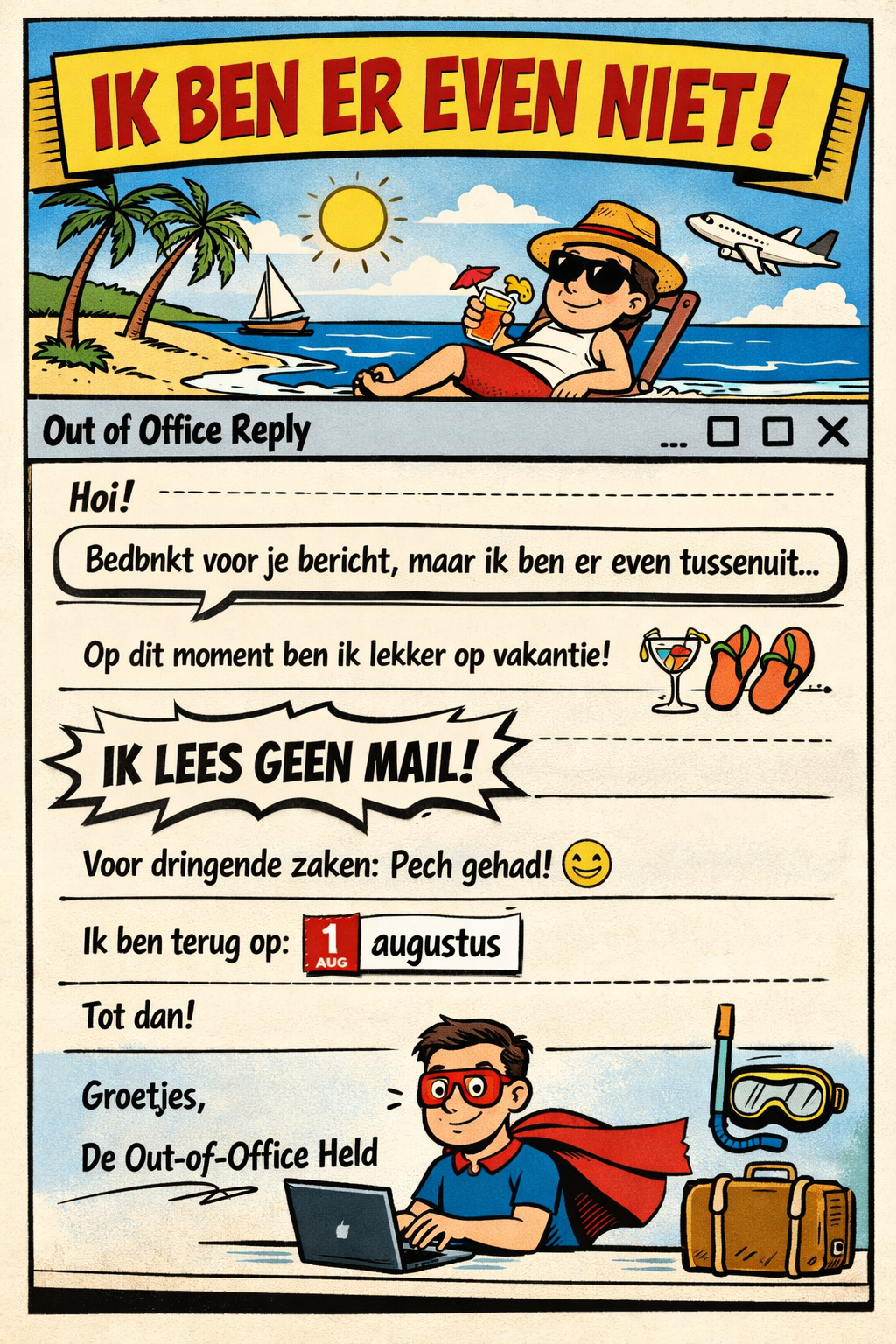
During the first lockdown I once received an OoO from a colleague; an out-of-office reply. "But surely everyone is Out-of-Office right now?", I thought at the time. I believe I even emailed her to say so. She didn't find it particularly funny.
Ever since, I've been obsessed with the OoO. With the peculiar moments at which I sometimes receive one. Or with its content. With the enormous number of OoOs that flood my inbox whenever I send an invitation to all staff for the quarterly meeting. And with the phenomenon that the OoO has now even found its way into the email signature; name, title, address, phone number, and then, in italics, sometimes in a striking colour: "I work on Mondays, Tuesdays and Thursdays". Or: "away on Wednesdays and Fridays".
Look, I understand switching on the OoO when you're going on holiday for a week or two or three. Or if you have a job where urgent matters regularly come up that genuinely hinge on minutes or hours. And then you leave the name and email details of your backup. Neat and professional. And you have to be careful not to refer to someone who's also OoO. But apart from that; an OoO on a Friday? If I send someone an email at 3.01pm on a Friday afternoon, and receive an OoO at 3.02pm in reply, then I too already have my head half in the weekend. In the office and yet absent, so to speak. I hadn't expected an answer that day anyway, so what added value does such an OoO actually have?
“In the office and yet absent.”
The finest OoO I ever received was from a client: "Dear reader, today I'm at a symposium on breast cancer. I'm going to write a blog about it. Check our website etc etc". Brilliant. Simply turning the OoO into a nice little message.
Back to the weekly OoO you receive on a Wednesday afternoon from a colleague who then dutifully answers your email on Thursday. Without that OoO I might not even have noticed his or her absence (does that make me an inattentive colleague?). I myself never switch on my OoO, except when I go on my summer holiday. I'm a workaholic, and I don't mind being called or messaged during short breaks. My summer holiday and Christmas holiday, on the other hand, are sacred to me. Then I arrange good cover, and there's only one colleague allowed to call or message me in case of emergency.
There are also people who actually enjoy switching on that OoO. I suspect it's a form of thoroughness that gives them peace of mind. I find it rather endearing, actually. Someone who, every single week, switches on the OoO for just one day. Pure dedication. Or could it, for some, stem from a feeling of being indispensable? Or from fear of what might go wrong in those 12 hours they're not checking their inbox?
I might as well be honest: I'm not a fan of the OoO. "Dear Sender." Yuck. They're usually ugly and impersonal texts. Not nice to receive. Being automatically informed by a colleague, client or supplier that you made an effort to send that email for nothing. You could just as well have waited a day.
Deep down, OoOs make me a little sad. They illustrate that we're all afraid of missing something, that we might be judged if we don't reply immediately. The OoO as self-protection. It says something about the stress and expectations we're weighed down by in our working lives. And, either way, it says more about the needs of the sender of the OoO than about the needs of the person receiving it. Is that person even waiting for an OoO?
“The OoO as self-protection.”
The essence of the OoO reply is that it emphasises what isn't there. What's missing. I'm going to design an OoO-reply-reply function. Every time I receive an OoO, it will automatically email back:
"Dear absent one, you're brilliant! I can't wait for you to be back. Even if you haven't yet had time for my email; I'm a fan of your work regardless. And of you! Whether you're OoO or not."
Share this column
Martijn Nap is an epidemiologist and health economist, trained at Radboud University. For over 25 years he has worked at the intersection of healthcare, data, technology, marketing and strategy, both internationally and in the Netherlands. For four years he was general manager of IQVIA Netherlands, the global leader in healthcare data, analytics and AI. Before that he held international leadership roles in the life sciences sector. Through Third Force Advisory he advises executives and organisations on the future of health, healthcare transformation and societal strategy.