It is hard to hunt and gather with broken hips
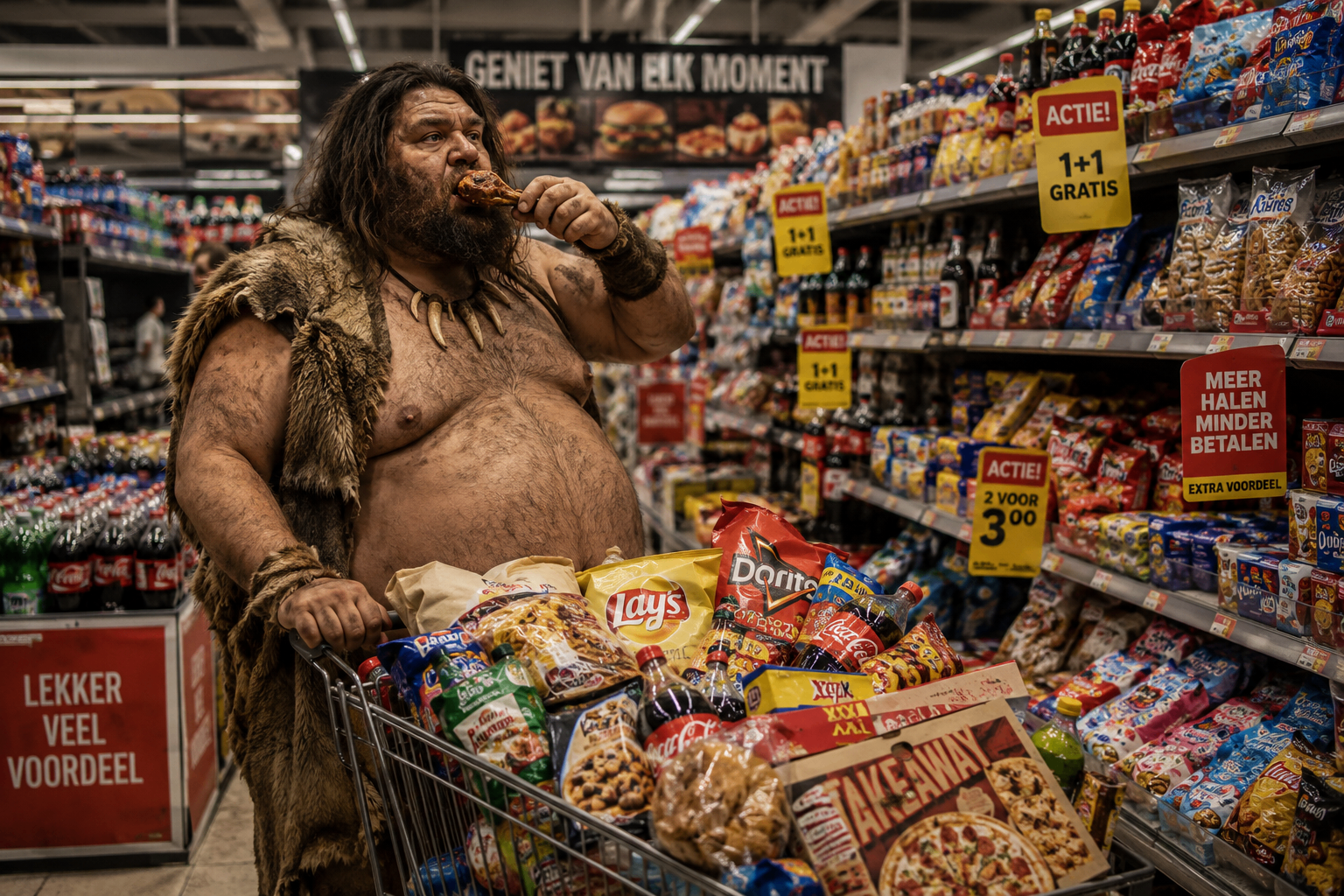
In paediatric wards, children's hips are now collapsing under the weight of excess weight. The only other place in the animal kingdom where you see this is in broiler chickens raised for meat. How can this be? The simple answer is: taking in more calories than you burn — exceptions for metabolic disorders and hereditary conditions aside. And how, then, can there have been such an explosion in excess weight over the past 30 years? Our DNA hasn't suddenly changed drastically in 30 years.
The answer to that question is clear too: we've started moving less, and eating more and less healthily (and sleeping worse, for that matter). We now have to contend with "food nagging" and an "obesogenic food environment." As a lover of language I find those beautiful terms, but as an epidemiologist and health economist I find them mainly extremely worrying. So the real question is: how did we get here? Let's put this trend into historical perspective.
Thousands of years ago, we had to scrape together whatever we could find. There was barely any food at all. So if there was something to eat: grab it quickly and stuff it in your mouth! Hunting and gathering. We are evolutionarily programmed to immediately eat whatever is put in front of us, and if we occasionally manage to eat too much, we store that energy as fat, so we have a reserve supply for lean times. So it's essentially in our DNA to get fat whenever there's enough food around us.
“It's in our DNA to get fat whenever there's enough food around us.”
Then someone came up with the brilliant idea of locking our food up behind a few fences. That way we no longer needed to hunt and gather. Genius! And so agriculture was born. This was still hard work, though, so humans still burned more than enough calories to maintain a healthy weight.
Until the industrial revolution; suddenly part of the work became less labour-intensive, and we were able to produce food on an industrial scale using machines. And even that still went remarkably well in terms of body weight, especially in the predominantly Calvinist Netherlands, where excess is frowned upon and the prevailing ethos was "just act normal, that's crazy enough already," worn with the proverbial "blue button" of restraint, and cycling to work.
After the Second World War, food production gained an extra dimension: no more hunger! There had to be enough food, always and everywhere, and after the Hunger Winter (the Dutch famine of 1944–45) we were all raised to believe it was good to finish everything on your plate. Even if you were already full. "Finish your plate first, or you can't leave the table." On top of that came economic motives from the government during post-war reconstruction: agriculture became a major industry with a strong lobby in The Hague, and so we became one of the few countries with a government-subsidised milk lake, a butter mountain, and a surplus of sugar beet. I've heard it said that during the reconstruction period, it was decided in the Netherlands that soft drinks had to be extra sweet by law, because the sugar beet surplus needed using up. There are, by the way, few countries in the world where people voluntarily keep drinking milk past the age of four, but in the Netherlands we came to believe it was normal.
After reconstruction came "de-pillarisation" (the breakdown of the Netherlands' rigid religious and ideological social pillars), which freed us from norms and values imposed simply by which "pillar" you happened to be born into: Protestant, Catholic or socialist. As a side effect of de-pillarisation, we were left with a collective lack of purpose in return, which resulted in the wonderful, hedonistic and nihilistic 1990s, in which enjoyment became more or less equated with being happy and successful. In my view, Rutte (former Dutch prime minister Mark Rutte), a fellow fan of the nineties like myself, is still the political embodiment of that era with his legendary line: "The climate is under pressure, but that doesn't mean we can't still enjoy a nice barbecue." There you have the problem of runaway neoliberalism, summed up in one visionless quote. In practice, this essentially means that happiness and success have come to be equated with consumption, with a growing Gross National Product as the government's ultimate goal.
Meanwhile, the science behind marketing hasn't been standing still either, and we've now ended up in the era of neuromarketing, influencers and AI algorithms. Marketing that goes straight for your spinal cord and makes us buy and consume things automatically without us consciously realising it. In the 1990s, those marketing practices for food and drink spread from the US to Europe and Asia. More than half of the Dutch population is now overweight, putting enormous pressure on healthcare as a result.
I can't help but conclude that the main cause of this obesity epidemic can be traced back to the industrialisation and commercialisation of our food chain. From field to plate, every step contains financial incentives that all point in one direction: more, more efficient, and easier.
“From field to plate, every step contains financial incentives that all point in one direction.”
On the field: produce more per hectare (harvest twice a year if at all possible), more meat per chicken, more milk per cow, and so on. On to the factory: process efficiently, large packaging, long shelf life thanks to plenty of preservatives. Then the supermarket: 80% of the range is unhealthy or unnecessary, and 80% of the promotions concern unhealthy food and drink. It's all about margins and volume. Then the marketing: enticing colours and smells in the supermarket, illogical layouts designed to make us lose our way and buy more, little daylight to heighten our susceptibility to impulse buying, the optimal music mix for maximum relaxation (because relaxed people buy more), promotions at the end of every aisle, vegetables first to ease the conscience, then the unhealthy products, sweets at the checkout, and endless shelves with a dizzying array of flavours and varieties of chocolate, breakfast cereal, soft drinks, beer and snacks. And finally the kitchen and dinner table; time pressure on dual-income households and financial stress on those on low incomes mean we want cheap meals that can be prepared quickly and that nobody will complain about at dinner. In other words: ready-made, lots of plastic, ultra-processed, plenty of sugar and salt, few vegetables, and definitely not fresh.
We're becoming overweight, the quality of our soil and drinking water is deteriorating, bees are dying out because of agricultural pesticides, with a rise in Parkinson's disease as a bonus, and we're clearing rainforest to grow animal feed. That's why it's high time that, at every step of the food chain, financial incentives are aligned with just two things: health and sustainability. From field to plate. We created an obesity epidemic in 30 years; in this age of A.I., it ought to be possible to reverse it in under 30 years. If only for the sake of those poor children whose hips are collapsing under the weight of happiness and success.
Share this column
Martijn Nap is an epidemiologist and health economist, trained at Radboud University. For over 25 years he has worked at the intersection of healthcare, data, technology, marketing and strategy, both internationally and in the Netherlands. For four years he was general manager of IQVIA Netherlands, the global leader in healthcare data, analytics and AI. Before that he held international leadership roles in the life sciences sector. Through Third Force Advisory he advises executives and organisations on the future of health, healthcare transformation and societal strategy.